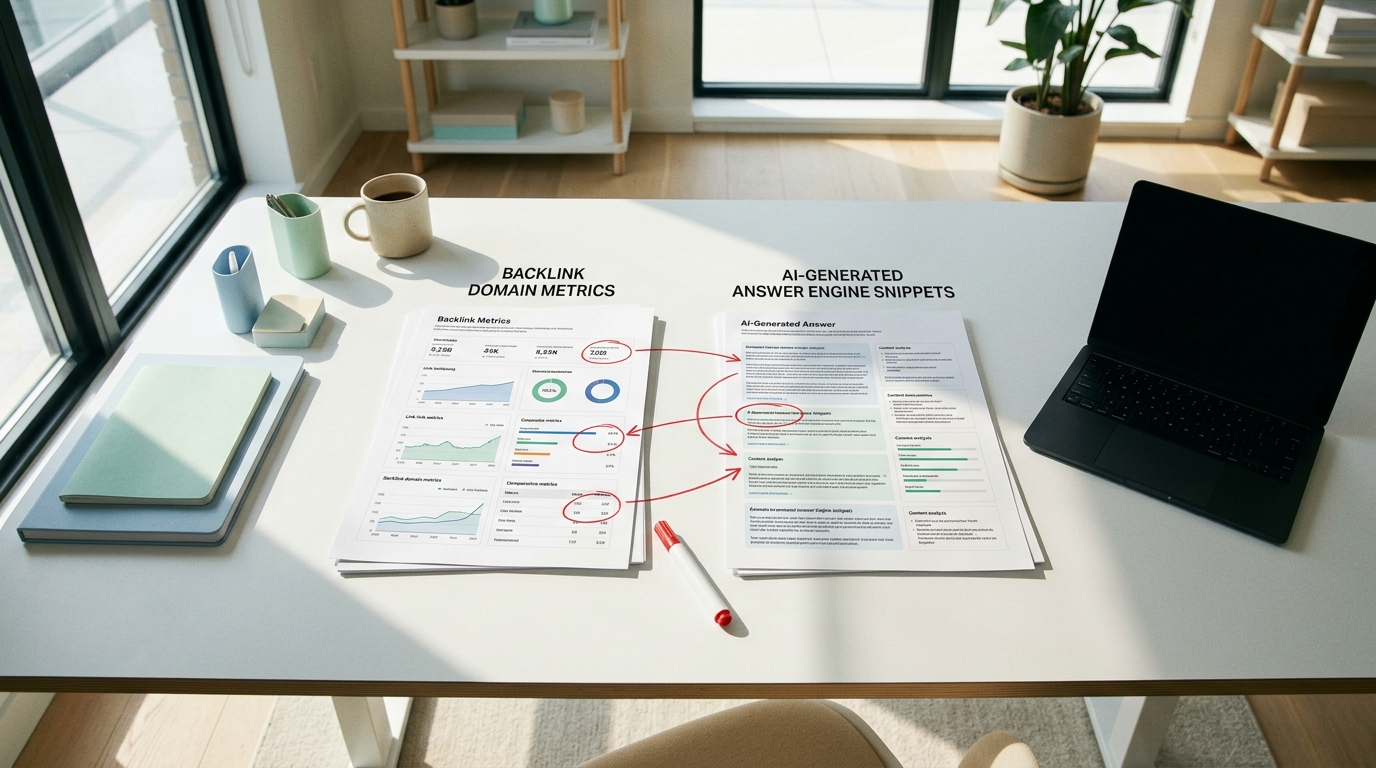
AI citations and organic links serve distinct but complementary roles for SEO in 2026. While high-authority organic links remain the foundational signal for domain authority and rankings in traditional blue links, AI citations directly influence visibility within generative AI Overviews and conversational search results, making them critical for capturing top-of-funnel, intent-driven traffic.
Deconstructing the 2026 Search Landscape: Two Battlefields, One War
For over two decades, the primary goal of SEO was to acquire high-quality backlinks to signal authority to search engine crawlers like Googlebot. This strategy focused on ranking in the "10 blue links." That battlefield still exists and remains fundamentally important. However, the widespread integration of AI Overviews, Gemini, Perplexity, and other generative AI into the search experience has created a second, parallel battlefield: the answer engine.
In 2026, a comprehensive SEO strategy must address both. Winning in one does not guarantee victory in the other. A law firm could have hundreds of authoritative backlinks from legal directories and news sites, securing a top-three organic ranking, yet be completely absent from the AI Overview that summarizes "best personal injury lawyers near me." Conversely, a new dental practice might get cited in an AI-generated answer for "emergency root canals on a Saturday" because its Google Business Profile data is perfectly structured, even while its backlink profile is still developing.
The core difference is the source of trust:
- Organic Links: Trust is inferred from the editorial judgment of other humans. A link from a reputable industry publication to your website is a vote of confidence. This builds long-term Domain Authority.
- AI Citations: Trust is derived from structured data, factual consistency, and entity recognition. The AI model trusts that your business hours are 9 AM–5 PM because that data is consistent across your GBP, website schema, and major directories. This builds topical and factual authority for the AI's knowledge graph.
Ignoring either of these trust signals is a critical mistake. Organic links are the bedrock of your site's overall authority, influencing its potential to rank for a wide array of terms. AI citations are the key to capturing high-intent users who receive direct answers, bypassing the traditional click-through process.
What is Generative Engine Optimization (GEO)?
Generative Engine Optimization (GEO) is the practice of structuring and presenting information to be easily discoverable, verifiable, and synthesizable by large language models (LLMs) and generative AI systems. Unlike traditional SEO, which targets keyword-based retrieval and ranking algorithms, GEO focuses on becoming a trusted source within the AI's knowledge base. Its goal is to have your brand, data, or content featured directly in AI-generated answers, summaries, and recommendations.
Key pillars of GEO include:
- Entity-Based SEO: Ensuring your business is a well-defined "entity" in Google's Knowledge Graph with consistent Name, Address, and Phone number (NAP) data.
- Structured Data Markup: Using Schema.org vocabulary to explicitly label key information on your website, such as services offered, service areas, operating hours, and professional credentials.
- Factual Content & Data Syndication: Publishing clear, factual, and easily citable information and ensuring its consistency across authoritative third-party platforms (e.g., industry directories, data aggregators).
- Reputation & Sentiment Analysis: Managing online reviews and public sentiment, as AI models use this data to gauge trustworthiness and user satisfaction.
Think of it this way: traditional SEO gets you on the library shelf. GEO gets you cited in the librarian's answer to a visitor's question.
Tactical Comparison: Building Links vs. Earning Citations
The workflows for acquiring organic links and earning AI citations are fundamentally different. While they can be mutually beneficial, they require distinct strategies and resources. A home services company, for example, would approach earning a link from a major home improvement blog very differently from how it would ensure its "24-hour emergency plumbing" service is cited by an AI Assistant.
| Factor | Organic Link Building | AI Citation Building (GEO) |
|---|---|---|
| Primary Goal | Increase Domain Authority; pass "link equity" to improve rankings in traditional search results. | Become a canonical, trusted source for an AI model's knowledge graph; appear in AI Overviews. |
| Core Tactic | Digital PR, content marketing, guest blogging, broken link building, relationship outreach. | Structured data implementation (Schema.org), Google Business Profile optimization, knowledge panel management, data syndication. |
| Source of "Authority" | The reputation, relevance, and traffic of the linking domain. A link from Forbes is more valuable than one from a new blog. | Data consistency, specificity, and verification across multiple trusted sources. Accuracy is paramount. |
| Time to Impact | Medium to long-term (weeks to months). Search engines need time to crawl, index, and re-evaluate authority. | Short to medium-term (days to weeks). Correcting a GBC profile or deploying schema can yield results quickly. |
| Key Metric for Success | Domain Authority (DA) score, number of referring domains, organic keyword rankings, referral traffic. | Inclusion in AI Overviews, brand mentions in generative answers, clicks from citation links (when provided). |
| Example Action | A roofer writes a definitive guide to storm damage assessment and gets it linked by a regional weather blog. | The same roofer uses Service and areasServed schema to explicitly state they offer "emergency roof tarping" in 5 specific zip codes. |
How to Get Your Business Cited by AI Search in 2026
Optimizing for AI citations requires a meticulous, data-first approach. LLMs prioritize verifiable facts over marketing fluff. Here are the essential strategies for service businesses, from multi-location franchises to solo law practitioners.
1. Master Your Local Search Knowledge Graph
For any service-area business, your local presence is the foundation of your AI visibility. AI models heavily rely on established business databases to answer location-based queries like "orthodontists near me that offer Invisalign."
- Google Business Profile (GBP) Perfection: Your GBP is no longer just a listing; it's your primary data feed to Google's AI. Every field must be complete and accurate: services, service areas, hours (including holiday and special hours), appointment links, accessibility attributes, and photos. Use the Q&A feature to preemptively answer common questions.
- NAP Consistency is Non-Negotiable: Your business Name, Address, and Phone number must be identical across your website, GBP, social media profiles, and major data aggregators like Data Axle and Neustar Localeze. Even minor variations (e.g., "St." vs. "Street") can create ambiguity for an AI.
- Cultivate Reviews: AI models use review volume, velocity, and sentiment as a primary proxy for quality and trustworthiness. A steady stream of recent, positive reviews signals to the AI that your business is active and reputable.
2. Implement Hyper-Specific Schema.org Markup
Schema.org is a vocabulary of structured data that you add to your website's HTML. It translates your human-readable content into a machine-readable format that AI can understand unequivocally. Go beyond basic LocalBusiness schema.
- For Medical & Dental: Use
MedicalClinic,Physician, orDentistschema. SpecifymedicalSpecialty(e.g., Orthodontics), and list everyavailableServiceandhealthConditionyou treat. This is how you get cited for "pediatric dentist for kids with anxiety." - For Home Services: Use
HomeAndConstructionBusinessand be exhaustive in yourhasOfferCatalog, listing every single service from "drain snaking" to "tankless water heater installation." Use theareasServedproperty to list every city, county, or zip code you cover. - For Law Firms: Use
LegalServiceschema. Specify yourareaServedand list every practice area under thehasOfferCatalogproperty (e.g., "Commercial Real Estate Litigation," "Chapter 7 Bankruptcy Filing"). Link to attorney profiles marked up withAttorneyschema.
Platforms like WorkspaceCMS build this detailed, conversion-focused schema directly into the website's structure, ensuring that as you add services or locations, your structured data is automatically updated to feed AI engines.
3. Create "Citable" Factual Content
AI doesn't want to interpret your beautiful prose; it wants to extract facts. Structure your website content to be a definitive source of information about your services, location, and industry.
- Service Pages as Data Hubs: Each service page should contain clear, factual statements. Instead of "We offer premier HVAC solutions," write "We provide installation, repair, and maintenance for central air conditioners, heat pumps, and ductless mini-split systems." Include FAQs on each page that directly answer common user questions.
- Use Tables and Lists: Structure data like service comparisons, pricing tiers, or covered service areas in HTML tables (
<table>) and lists (<ul>,<ol>). This format is incredibly easy for AI to parse and repurpose in an answer. - Authoritative About Us/Team Pages: Detail your company's history, licenses, certifications, and awards. For professional services, create detailed biographies for each practitioner, marking them up with
PersonorAttorneyschema to establish expertise, experience, and credentials (E-E-A-T).
4. Leverage First-Party and Third-Party Data
AI models build confidence through corroboration. They trust information more when it's confirmed by multiple reliable sources. Your website is your primary source, but it can't be your only one.
- First-Party Data (Your Website): This is the canonical source you control. Your website, especially a conversion-focused platform like WorkspaceCMS, is the hub. It's where you implement schema, publish factual content, and state definitively who you are, what you do, and where you do it.
- Third-Party Data (External Validation): This includes your GBP, industry-specific directories (e.g., Avvo for lawyers, Thumbtack for contractors), and local citations. Consistency between your first-party and third-party data is the single most important factor for building AI trust. Any mismatch creates uncertainty and reduces your chances of being cited.
The Symbiotic Relationship: How Links and Citations Work Together
In 2026, the most successful SEO strategies don't treat organic links and AI citations as an either/or proposition. They recognize that one feeds the other in a virtuous cycle.
Consider a multi-location dental franchise. Their corporate marketing team executes a digital PR campaign, publishing a data-driven study on the rise of cosmetic dentistry. This study earns high-authority backlinks from national news outlets and health blogs. This influx of link equity boosts the entire domain's authority.
Simultaneously, each local franchise location has a perfectly optimized GBP and a location-specific webpage built on WorkspaceCMS. These pages use Dentist and Service schema to detail that they offer "teeth whitening" and "dental veneers."
Here’s how the synergy works:
- The high domain authority from the backlinks signals to Google that the entire website is a trustworthy source.
- When a user searches "best cosmetic dentist in Austin," the AI model is already primed to trust the dental franchise's domain.
- The AI then looks for the most specific, factually relevant information. It finds the Austin location page, validates the "teeth whitening" service via its schema, and corroborates the address and hours with the location's GBP listing.
- The result: The franchise's Austin clinic is cited directly in the AI Overview, complete with a link to its local page, because its high-level authority (from links) was combined with its ground-level factual accuracy (from GEO tactics).
Without the backlinks, the AI might have less confidence in the domain overall. Without the specific schema and local data, the AI wouldn't have the granular facts needed to recommend a specific location for a specific service. Both are required for maximum visibility.
The Verdict: Which is More Valuable in 2026?
For service-based businesses, AI citations are delivering more immediate, high-intent value in 2026, while organic links remain essential for long-term, foundational authority.
If your B2B manufacturing company is trying to rank for a competitive, research-heavy keyword, the authority conferred by organic links from industry publications is paramount. The buyer journey is long, and establishing deep credibility is key.
But if you are a multi-location restaurant franchise and a user asks their AI assistant for "a family-friendly restaurant with a gluten-free menu open now," the only thing that matters is getting cited in that instant, transactional answer. This is driven entirely by structured data, GBP accuracy, and menu information, not by backlinks from food bloggers.
The winning strategy is to pursue a dual-track approach. Invest in building a rock-solid technical and local SEO foundation designed for AI citation. Use a platform like WorkspaceCMS to ensure your services, locations, and credentials are perfectly structured. At the same time, continue to create valuable content and build relationships that earn authoritative backlinks, which will lift the authority of your entire digital presence and increase the likelihood that AI models will consider you a trusted source in the first place.
AI Search Ranking Factors FAQ
What is the most important factor for getting cited by AI?
Factual consistency across multiple trusted sources is the most critical factor. An AI model must be able to verify your key business information (Name, Address, Phone, Services, Hours) on your website, your Google Business Profile, and other authoritative directories. Discrepancies create doubt and will prevent you from being cited.
Do backlinks still matter for AI Overviews?
Yes, but indirectly. High-authority backlinks increase your website's overall Domain Authority, signaling to Google that you are a trustworthy entity. While the AI doesn't "count" the links for the Overview directly, it is more likely to use a domain it already trusts as a source for its answers. Backlinks build the foundation of trust that GEO capitalizes on.
How long does it take to see results from Generative Engine Optimization (GEO)?
The impact of GEO can be much faster than traditional link building. After correcting your Google Business Profile data or deploying comprehensive Schema.org markup on your website, you can be cited in AI Overviews in a matter of days or weeks, as soon as Google's crawlers process the new, structured information.
Can I appear in an AI Overview without a top organic ranking?
Absolutely. This is common for service-area businesses. A plumbing company could rank #7 organically for "water heater repair" but be the sole business cited in the AI Overview because its GBP and website schema perfectly match the user's specific intent (e.g., "24/7 emergency service for Rheem water heaters").
