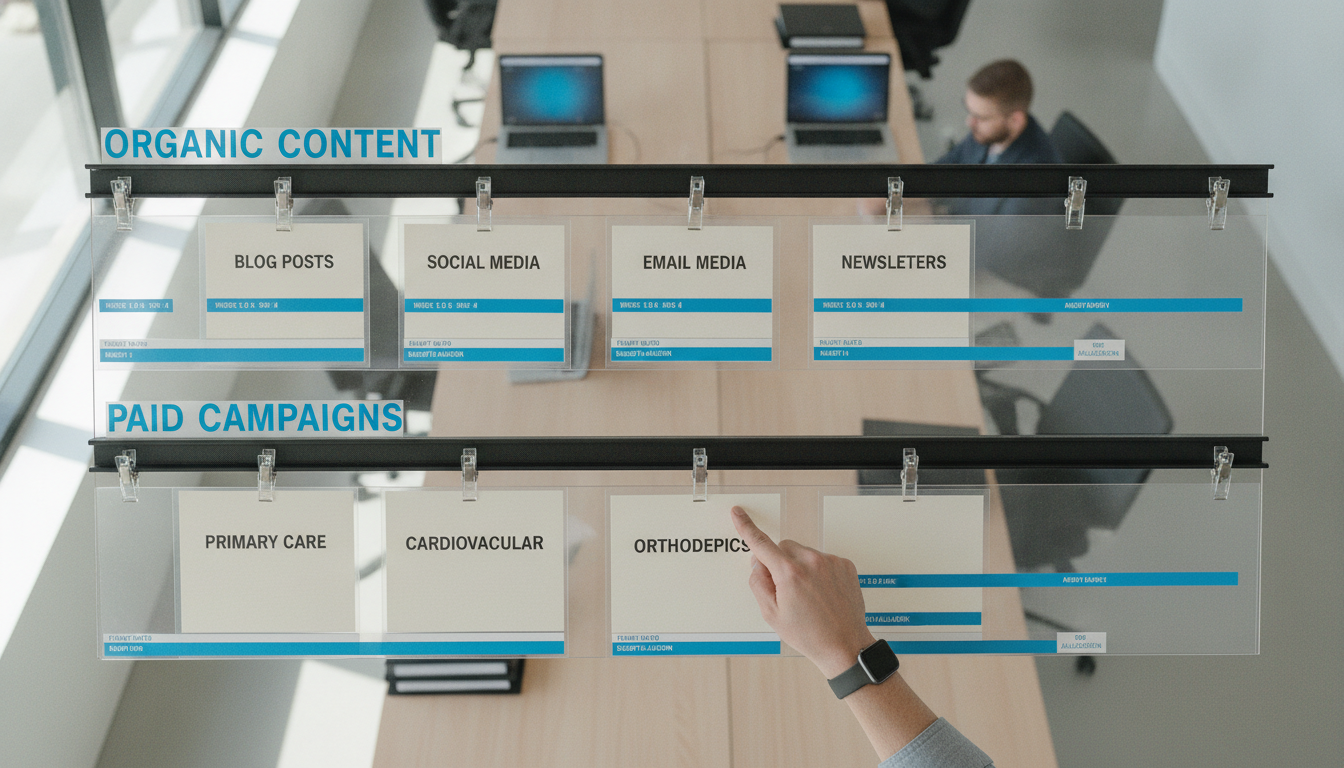
Paid and organic search are both essential patient acquisition strategies for healthcare providers in 2026, but they serve different purposes. Organic search (SEO) builds long-term trust and authority, attracting over 70% of search clicks, while paid search (PPC) offers immediate visibility and precise targeting for high-intent patient queries.
For healthcare practices, from multi-location hospital systems to solo dental clinics, the debate isn't about choosing one over the other. It's about strategic allocation. A balanced approach leverages the strengths of each channel to create a resilient, full-funnel growth engine. Organic search is the foundation for sustainable growth, establishing your practice as a credible medical authority. Paid search acts as a powerful accelerator, driving immediate patient leads for specific, high-value services.
This framework will break down the strategic considerations for allocating your 2026 marketing budget between medical SEO and healthcare PPC, focusing on the unique compliance, trust, and local visibility challenges inherent in the industry.
The Foundational Role of Organic Search (SEO) in Healthcare
Organic search is the non-negotiable bedrock of digital marketing for any medical or dental practice. Why? Trust. When a potential patient is searching for sensitive health information or a new provider, the unbiased, algorithmically ranked results of organic search carry significantly more weight than a paid advertisement. A 2025 study by BrightEdge confirmed that organic search continues to be the dominant channel, driving 53% of all trackable website traffic across industries, a figure that is often higher in trust-sensitive sectors like healthcare.
For healthcare providers, SEO is not just about keywords; it's about demonstrating Expertise, Authoritativeness, and Trustworthiness (E-A-T), a core component of Google's search quality guidelines that is applied with the highest scrutiny to "Your Money or Your Life" (YMYL) topics like medical advice.
Key Advantages of Medical SEO:
- Builds Long-Term Trust and Credibility: Ranking organically for conditions, treatments, and "best doctor near me" queries positions your practice as a leading authority. Patients are more likely to trust a practice that Google has vetted as a top result.
- Drives High-Quality, Sustainable Traffic: Once you achieve high rankings, you don't pay for every click. This creates a sustainable flow of qualified patient traffic that continues to deliver value long after the initial investment.
- Higher Click-Through Rates (CTR): The top organic result on Google receives an average CTR of over 27%, according to 2026 Sistrix data. This is exponentially higher than the typical 2-5% CTR for paid search ads.
- Asset Creation: The content created for SEO - service pages, blog posts about symptoms and treatments, physician bios - becomes a permanent asset for your practice, educating patients and building your brand 24/7.
- Local Map Pack Dominance: For healthcare, local visibility is paramount. A strong medical SEO strategy is the primary driver for appearing in the Google Local Map Pack, which is often the first thing a patient sees when searching for local care.
Challenges and Considerations for Medical SEO:
- Time-Intensive Results: SEO is a long-term investment. It can take 6–12 months to see significant results, especially in competitive metropolitan markets.
- Resource-Heavy: Effective medical SEO requires consistent effort in technical optimization, content creation by subject matter experts (physicians, nurses), and building local citations.
- Algorithm Volatility: Google's algorithms are constantly changing. Practices must stay informed and adapt their strategies to maintain rankings, particularly after major updates like the 2025 Helpful Content Update refinements.
The goal of organic search is to make your practice the definitive, trusted resource in your market and specialty. It’s an investment in your brand's digital authority that pays dividends for years.
The Strategic Role of Paid Search (PPC) for Patient Acquisition
While SEO builds your foundation, paid search, or pay-per-click (PPC) advertising, is your growth accelerator. Platforms like Google Ads and Microsoft Ads (formerly Bing Ads) allow you to place your practice directly at the top of the search results for specific, high-intent keywords, delivering immediate visibility to patients actively seeking care.
In healthcare, PPC is invaluable for promoting high-value services, filling appointment slots quickly, and competing in crowded markets. The key is precision targeting and strict adherence to compliance standards, particularly around HIPAA and advertising policies for health-related services.
Key Advantages of Healthcare PPC:
- Immediate Visibility and Traffic: A new PPC campaign can be live and driving traffic to your website within hours. This is ideal for launching a new service line, promoting a new specialist, or reacting to market changes.
- Granular Targeting: You can target patients based on precise keywords ("emergency dentist dallas"), geography (a 5-mile radius around your clinic), demographics, and even time of day. This minimizes wasted ad spend.
- Measurable ROI: Every click, conversion (form submission, phone call), and cost is tracked. This allows for precise calculation of cost-per-lead (CPL) and return on investment (ROI), making it easy to justify budget allocation.
- A/B Testing and Optimization: PPC platforms provide a perfect environment for testing. You can run multiple versions of ad copy, landing pages, and calls-to-action to identify what resonates most with potential patients and continuously improve performance.
- Competitive Edge: If your competitors are dominating the organic results, PPC allows you to instantly appear above them, capturing a share of that high-intent traffic.
Challenges and Considerations for Healthcare PPC:
- HIPAA Compliance: This is the most critical challenge. You must ensure your campaigns are configured to be HIPAA compliant. This includes avoiding remarketing based on sensitive health information and using secure, encrypted landing pages and forms. Working with a HIPAA-compliant marketing agency is non-negotiable.
- Cost and Budget Management: PPC is a pay-to-play model. Costs can escalate quickly, especially for competitive keywords like "orthopedic surgeon" or "invisalign provider." Without careful management, it's easy to exhaust your budget with little to show for it.
- Ad Platform Policies: Google and other platforms have stringent policies against advertising certain medical procedures, pharmaceuticals, and making unsubstantiated claims. Ads can be disapproved for minor infractions, halting campaigns instantly.
PPC is a powerful tool for on-demand patient generation. Its strength lies in its speed, control, and measurability, making it the perfect complement to a long-term SEO strategy.
Organic vs. Paid Search: A Head-to-Head Comparison for Medical Practices
Understanding the fundamental differences between these two channels is key to allocating your budget effectively. Here’s a direct comparison based on the factors that matter most to healthcare providers in 2026.
Medical SEO vs. Healthcare PPC
| Factor | Organic Search (SEO) | Paid Search (PPC) |
|---|---|---|
| Time to Results | Slow (6–12+ months for competitive terms) | Fast (immediate visibility within hours) |
| Cost Model | Investment in resources (content, technical) | Direct payment per click or impression |
| Long-Term Value | High; rankings are a durable asset | Low; traffic stops when you stop paying |
| Patient Trust | Very High; seen as an unbiased endorsement | Moderate; clearly marked as an advertisement |
| Targeting Precision | Broad (topic-based); less granular control | Very High (keyword, location, device, time of day) |
| ROI Measurement | More complex to attribute; focuses on channel growth | Direct and precise; easy to calculate CPL and ROI |
| Ideal Use Case | Building brand authority, educating patients, dominating local search | Promoting high-value services, filling immediate openings, testing offers |
The 2026 Budget Allocation Framework: An Integrated Approach
The most successful healthcare marketing strategies don't treat SEO and PPC as separate silos. They use them in concert, with data from one channel informing the other. This creates a powerful flywheel effect where the whole is greater than the sum of its parts.
Phase 1: New Practice or New Website (First 6–12 Months)
For a new practice or one with a brand-new website, organic authority is zero. In this phase, PPC must do the heavy lifting to generate initial patient flow while the SEO foundation is being built.
- Budget Allocation: 70% PPC / 30% SEO
- SEO Focus: Technical SEO setup (site speed, mobile-friendliness), Google Business Profile optimization, building foundational service pages and location pages, and citation building.
- PPC Focus: Target high-intent, "bottom-of-funnel" keywords for your most profitable services (e.g., "dental implants cost," "same-day crown near me"). Drive traffic to high-converting landing pages to generate immediate leads and revenue.
- Integration Strategy: Use keyword data from your PPC campaigns (which keywords convert to patients?) to prioritize your SEO content strategy. If "pediatric dentist for special needs" is a high-performing PPC keyword, create a comprehensive SEO-optimized service page and blog posts on that topic.
Phase 2: Established Practice with Some Authority (12–24 Months)
After a year of consistent SEO effort, your practice should start seeing some organic rankings and traffic. Now, you can begin to balance the budget allocation and use the channels more synergistically.
- Budget Allocation: 50% PPC / 50% SEO
- SEO Focus: Expand content to address "mid-funnel" patient questions (e.g., "what are the signs of gum disease?", "benefits of physical therapy after surgery"). Focus on acquiring high-quality backlinks from local organizations and health directories to build authority.
- PPC Focus: Shift some budget away from keywords where you now rank well organically. Use PPC to defend your brand name ("brand protection" campaigns), target competitor keywords, and test new service offerings before committing SEO resources.
- Integration Strategy: Implement a "surround sound" approach. When a potential patient searches for a key service, they see your PPC ad at the top, your Google Map Pack listing, and your organic result on the first page. This overwhelming presence builds immense trust and dramatically increases the likelihood of a click.
Phase 3: Market Leader with Strong Organic Presence (24+ Months)
As a market leader, your organic presence is a powerful, lead-generating asset. SEO becomes the primary engine, while PPC is used for highly strategic, targeted initiatives.
- Budget Allocation: 30% PPC / 70% SEO
- SEO Focus: Defend and expand your top rankings. Focus on conversion rate optimization (CRO) for your organic traffic. Produce authoritative, long-form content (e.g., "The Ultimate Guide to Knee Replacement Recovery") that establishes your physicians as thought leaders.
- PPC Focus: Use PPC for hyper-specific campaigns with a clear, immediate ROI. This could be promoting a high-tech piece of equipment (e.g., a new 3D mammography machine), filling last-minute cancellations, or targeting out-of-market patients for specialized procedures.
- Integration Strategy: Use organic traffic data from Google Analytics 4 and Search Console to identify your most engaged audiences. Use this data to create highly targeted PPC display or video campaigns to re-engage past website visitors (where HIPAA compliant) or reach lookalike audiences.
Why a Conversion-Focused Website is Crucial for Both Channels
Whether the traffic comes from a paid ad or an organic search result, it's wasted if your website can't convert that visitor into a patient. Your website is the hub of your digital marketing efforts. A platform like WorkspaceCMS is designed specifically for service businesses to provide the features necessary for conversion.
A conversion-focused healthcare website must include:
- Clear Calls-to-Action (CTAs): "Request an Appointment," "Call Now," and "Find a Location" buttons should be prominent on every page.
- HIPAA-Compliant Forms and Chat: Patients need secure, easy ways to submit their information. All form submissions and online scheduling tools must be handled through a HIPAA-compliant system.
- Physician Bios and Social Proof: Patient trust is built on the credibility of your providers. Detailed bios, video testimonials, and patient reviews are essential.
- Fast Load Times and Mobile-First Design: Over 60% of health-related searches happen on mobile devices. Your site must be fast and flawless on a smartphone.
Investing in SEO and PPC without a website built to convert is like pouring water into a leaky bucket. The foundation must be solid to see a positive return on your marketing spend.
Healthcare Marketing FAQ
What is a good cost-per-lead (CPL) for healthcare PPC in 2026?
A good CPL varies dramatically by specialty and location. For general dentistry in a suburban market, a CPL of $25–$75 might be achievable. For a competitive field like orthopedic surgery in a major city, a CPL of $200–$400+ is more realistic. The key is to measure CPL against the lifetime value of a new patient for that specific service.
How does HIPAA affect my paid and organic search strategies?
For PPC, HIPAA prohibits targeting users based on sensitive health data. This means standard retargeting lists based on visits to specific treatment pages are generally not compliant. All landing pages and forms must be secure. For SEO, ensure any patient testimonials or case studies have signed release forms. Never discuss patient details in content without explicit, documented consent.
Can I just focus on SEO and ignore PPC?
You can, but you will grow much slower. While a pure SEO strategy can be effective over the very long term (24+ months), you will miss out on immediate patient leads. Competitors using PPC will capture patients who are ready to book an appointment now, while you wait for your organic rankings to mature.
Which is better for promoting a new, high-tech medical device?
PPC is almost always better for promoting a new, specific piece of technology or a niche service. You can create a highly targeted campaign around keywords for that device (e.g., "robotic spine surgery") and direct traffic to a dedicated landing page explaining the benefits. This allows you to generate leads and measure interest immediately, something that would take many months to achieve with SEO.
How long should I wait to see results from medical SEO?
You should see leading indicators of progress within 3–4 months, such as improved keyword rankings for less competitive terms and increased organic traffic. However, to see a significant impact on patient acquisition from high-value, competitive keywords, a 9–12 month timeframe is a realistic expectation in 2026.
