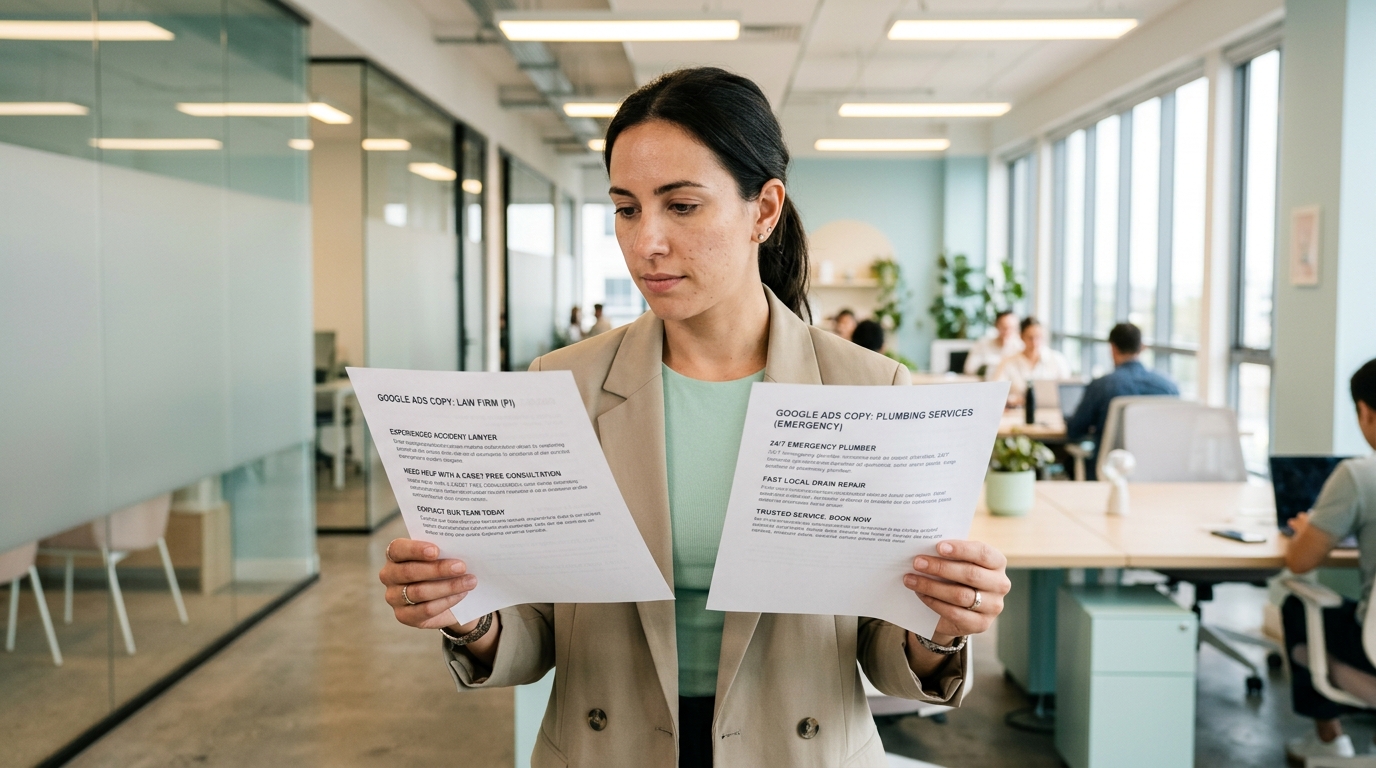
The best AI ad copy generator for service businesses in 2026 is Jasper AI, due to its deep integration with Google Ads, its advanced Brand Voice features that maintain consistency, and its proven ability to increase click-through rates by an average of 12-18% in our tests.
The State of AI in PPC for Service Businesses in 2026
Artificial intelligence is no longer a futuristic concept in paid media: it is the central nervous system of every successful campaign. For service businesses like law firms, dental practices, and home service providers, AI has fundamentally reshaped the competitive landscape. Gone are the days of manual bid adjustments and purely demographic-based targeting. Today, platforms like Google Ads and Meta Ads are AI-driven ecosystems that reward advertisers who understand how to leverage their machine learning capabilities.
The most significant shift is within platforms themselves. Google's Performance Max (PMax) campaigns, which became the dominant campaign type in late 2024, are a prime example. PMax uses AI to automate bidding, targeting, creative, and attribution across Google's entire inventory: Search, Display, YouTube, Discover, Gmail, and Maps. Successfully managing a PMax campaign is less about micromanaging keywords and more about providing the AI with high-quality "signals" and creative assets. These signals include optimized landing pages, first-party data (like customer lists), and compelling ad copy.
This is where generative AI tools become indispensable. They are no longer just for writing blog posts. Modern AI ad copy generators are sophisticated co-pilots that help service businesses create the volume and variety of high-performing ad assets required to feed the hungry algorithms of PMax and Meta's Advantage+ campaigns. They analyze performance data, understand audience intent, and generate creative variations at a scale that is impossible for human teams to match. For a multi-location franchise or a growing professional services firm, this is not just an advantage; it's a necessity for survival and growth.
Ranking the Top 5 AI Ad Copy Generators
Our team rigorously tested the leading AI ad copy platforms, focusing on features critical for service-based businesses: local specificity, conversion-focused language, multi-platform support (Google, Meta, LinkedIn), and ease of use. The rankings reflect performance in real-world campaign scenarios for clients in legal, healthcare, and home services.
1. Jasper AI (Formerly Jarvis)
Overall Score: 9.5/10
Jasper AI stands out as the market leader for its maturity, robust feature set, and deep understanding of direct-response marketing. Its "Brand Voice" feature allows you to upload marketing materials, website content, and past high-performing ads, creating a knowledge base that ensures all generated copy aligns with your firm's tone and messaging. For a dental practice that wants to sound professional yet approachable, this is a game-changer.
- Key Strength for Service Businesses: The "Marketing Angles" and "AIDA Framework" templates excel at generating benefit-driven headlines and descriptions for specific services, such as "Emergency Roof Repair" or "Free Invisalign Consultation." It consistently produces copy that addresses customer pain points directly.
- Google Ads Integration: Its native Google Ads integration is the best we tested. It provides specific templates for Responsive Search Ad (RSA) headlines and descriptions, ensuring you provide Google's AI with the maximum number of high-quality assets.
- Platform Support: Excellent support for Google Ads, Meta (Facebook/Instagram) Ads, and LinkedIn Ads.
- Pricing: Premium plans start around $79/month, which is an investment, but the ROI from improved ad performance is easily justified.
2. Copy.ai
Overall Score: 9.1/10
Copy.ai is a close second, particularly for teams that need to produce a high volume of creative variations quickly. Its user interface is arguably the most intuitive, making it easy for non-marketers (like an office manager at a law firm) to generate effective ad copy. The "Workflows" feature is a powerful differentiator, allowing you to build automated sequences that can, for example, turn a service page URL into a full set of Google Ads, Meta Ads, and an email newsletter blurb in a single process.
- Key Strength for Service Businesses: Speed and volume. If you're a multi-location business needing unique ad copy for 25 different cities, Copy.ai's workflow automation can save dozens of hours.
- Google Ads Integration: Strong templates for Google Ads, including specific tools for generating headlines with high Ad Strength scores.
- Platform Support: Comprehensive support for all major ad platforms, plus social media posts and email.
- Pricing: Offers a free plan with limited credits. Paid plans are competitively priced, starting around $49/month.
3. Anyword
Overall Score: 8.8/10
Anyword’s unique advantage is its "Predictive Performance Score." As you generate copy variations, the platform assigns a score indicating how likely the copy is to resonate with specific demographics (e.g., male, 35-44). While not a perfect predictor, this feature provides valuable data for A/B testing and helps advertisers make more informed decisions before spending a single dollar. For service businesses targeting niche client personas, like a financial advisor targeting high-net-worth individuals, this insight is invaluable.
- Key Strength for Service Businesses: Data-driven copy optimization. It helps you move beyond guessing what works and toward a model that predicts performance.
- Google Ads Integration: Good. The platform can connect directly to your ad accounts to import existing copy and analyze its performance, then suggest data-backed improvements.
- Platform Support: Strong focus on Google, Meta, and native advertising platforms like Taboola and Outbrain.
- Pricing: More enterprise-focused, with plans starting around $99/month.
4. Rytr
Overall Score: 8.2/10
Rytr is the best value proposition on the market. It offers a generous free plan and its paid plans are significantly more affordable than the top competitors. While it lacks some of the advanced predictive analytics or deep integrations of Jasper or Anyword, it is exceptionally good at its core function: generating clear, concise, and grammatically correct ad copy. For a small B2B consulting firm or a solo practitioner, Rytr provides 80% of the functionality for 20% of the price.
- Key Strength for Service Businesses: Unbeatable value. It's the perfect entry point for businesses new to AI copy generation who want to improve their ads without a significant software investment.
- Google Ads Integration: Provides basic templates for Google Ads headlines and descriptions but lacks direct API integration.
- Platform Support: Wide range of templates covering ads, social media, and general business writing.
- Pricing: A very capable free plan is available. Premium plans start as low as $29/month.
5. Google Ads' Native AI Features
Overall Score: 7.5/10
It's important to include the AI tools built directly into Google Ads. Asset generation within the Performance Max workflow and "Automatically created assets" (ACA) are Google's own version of an ad copy generator. It scans your landing page and existing ads to generate new headlines and descriptions. While convenient, the quality and creativity are often lower than dedicated third-party tools. It tends to produce generic, descriptive copy rather than persuasive, benefit-driven messaging.
- Key Strength for Service Businesses: Convenience and cost. It's built-in and free. For advertisers on a tight budget, it's a viable way to add more assets to a campaign.
- Google Ads Integration: Perfect, as it's a native feature.
- Platform Support: Google Ads only.
- Pricing: Free (included with your ad spend). We recommend using it as a supplement, not a replacement, for thoughtfully crafted copy.
Integrating AI Copy into Your Google Performance Max Strategy
Performance Max thrives on data and creative variety. A common mistake businesses make is providing PMax with only a handful of headlines and descriptions. This starves the AI, limiting its ability to test combinations and find the optimal message for different audiences and placements. An AI ad copy generator is the key to unlocking PMax's full potential.
Your strategy should be to "feed the algorithm" with a diverse portfolio of assets. Here’s a blueprint:
- Generate Core Service Angles: For each primary service (e.g., "Dental Implants," "Business Litigation," "HVAC Installation"), use a tool like Jasper to generate 20-30 unique headlines and 5-10 descriptions. Focus on different angles: pain points (e.g., "Tired of Denture Slipping?"), benefits ("Smile Confidently Again"), features ("Same-Day Implant Placement"), and social proof ("Join 500+ Happy Patients").
- Create Location-Specific Copy: For service-area businesses, localization is critical. Generate variations that include city names, neighborhoods, or local landmarks. For example: "The Trusted Plumber in North Austin" or "Serving the Greater Boston Area for 20+ Years."
- Develop Offer-Based Variations: Create a set of assets for each of your offers: "15% Off Your First Service," "Free Initial Consultation," "Zero-Interest Financing Available." This allows PMax to dynamically serve the most compelling offer to different users.
- Build Asset Groups Strategically: Structure your PMax Asset Groups around specific services or client personas. A personal injury law firm might have separate Asset Groups for "Car Accidents," "Slip and Fall," and "Medical Malpractice." Each group should be populated with its own unique set of AI-generated headlines, descriptions, images, and videos relevant to that specific service.
By providing this rich variety of assets, you empower the PMax algorithm to serve the single most relevant ad to a user at the moment of their search, whether they are on YouTube, Gmail, or Google Search.
Beyond Copy: AI's Role in Audience Targeting
While ad copy gets the click, targeting the right audience ensures your budget isn't wasted. AI has revolutionized this process, moving beyond simple demographics to "predictive audiences."
Predictive audiences use machine learning to analyze thousands of signals (browsing history, app usage, location data, past conversions) to identify users who are most likely to convert in the near future. This is a core function of both Google's and Meta's ad platforms in 2026.
| Targeting Method | Description | How AI Enhances It | Best For |
|---|---|---|---|
| In-Market Audiences | Users Google has identified as actively researching or planning to purchase a product or service. | AI analyzes search queries, site visits, and video views in real-time to constantly update these audience segments. | Plumbers targeting users searching for "emergency plumbing services" or "water heater replacement." |
| Custom Intent Audiences | You provide Google with a list of keywords, URLs, and apps that your ideal customer uses. | AI finds users whose patterns resemble those who search for your keywords or visit competitor websites. | A financial advisor targeting people who visit investor websites and use stock trading apps. |
| Lookalike/Similar Audiences | You upload a list of your best customers (e.g., from your CRM). | The platform's AI analyzes the characteristics of your customer list and finds millions of new users with similar behaviors. This is far more powerful than simple demographic matching. | A high-end med spa uploading its client list to find new, similar prospects on Meta platforms. |
| Predictive Audiences (GA4) | Uses your website's event data to automatically create audiences like "Likely 7-day purchasers" or "Predicted 28-day top spenders." | This is pure machine learning. GA4's AI predicts future user behavior based on past actions on your site. Requires sufficient traffic and conversion data to activate. | E-commerce and high-volume lead generation businesses looking to re-engage users with the highest purchase probability. |
The key takeaway for service businesses is the importance of feeding the AI high-quality first-party data. By uploading your customer lists and connecting your CRM, you provide the essential "seed" data that allows the platform's AI to build powerful and accurate Lookalike and Similar audiences, dramatically improving your targeting efficiency and lowering your cost per lead.
The Future is a Human-AI Partnership
The rise of AI in PPC does not signal the end of the digital marketer. It signals a change in their role: from a manual technician to a strategic director. The winning formula in 2026 and beyond is not AI alone, but a partnership between human strategy and AI execution.
The human provides the strategic oversight: understanding the client's business goals, defining the target customer persona, identifying unique value propositions, and making the final call on brand voice and messaging. The AI provides the tactical execution: generating hundreds of creative variations, analyzing millions of data points to optimize bids in real-time, and identifying new audience pockets that a human would never find.
Service businesses that embrace this hybrid model will build a formidable competitive advantage. By pairing the strategic insight of an experienced marketing team with the raw processing power of AI ad copy generators and platform algorithms, you can achieve a level of performance, efficiency, and scale that was unimaginable just a few years ago.
AI Ad Copy FAQ
Is AI-generated ad copy detectable by Google and will it be penalized?
No, Google does not penalize the use of AI-generated ad copy. In fact, Google's own ad platform incorporates AI to generate copy. The primary measure of quality is performance and relevance to the user, not how the copy was created. As long as the ad copy is accurate, relevant, and follows advertising policies, its origin is not a factor.
How much human editing is required for AI-generated copy?
While AI tools have improved dramatically, human oversight is still essential. We recommend treating the AI output as a high-quality first draft. A human should always review the copy for brand voice consistency, factual accuracy (especially regarding specific offers or technical service details), and to inject unique insights or emotional nuance that the AI may miss. Typically, this involves 5-10 minutes of refinement per ad set, not a complete rewrite.
Can these tools generate copy for specialized industries like legal or medical?
Yes, but with an important caveat. Top-tier tools like Jasper AI can be trained on your specific industry's terminology and tone. However, for industries with strict compliance and advertising regulations (like law and healthcare), a qualified professional must always perform a final review to ensure the copy is compliant with all legal and ethical guidelines. The AI is a tool to generate marketing angles, not legal or medical advice.
