Free strategy call and written scope for local, regional and national brands. Book yours →

Home / Industries / Manufacturing and Industrial / Solar Installers
Regional
Solar Installers marketing.
Solar sells on payback math under rules that keep changing. Homeowners want the number, and they want to know you will exist in year ten.
How do you market solar installers?
Solar marketing sells a long payback under rules that change. Homeowners search after a high utility bill or an incentive deadline, then compare quotes on financing, equipment and whether the company will exist to honor the warranty. The work is qualifying roofs and utility territory before the appointment, explaining incentives plainly, and building public proof against the industry's sales reputation.
See It Working
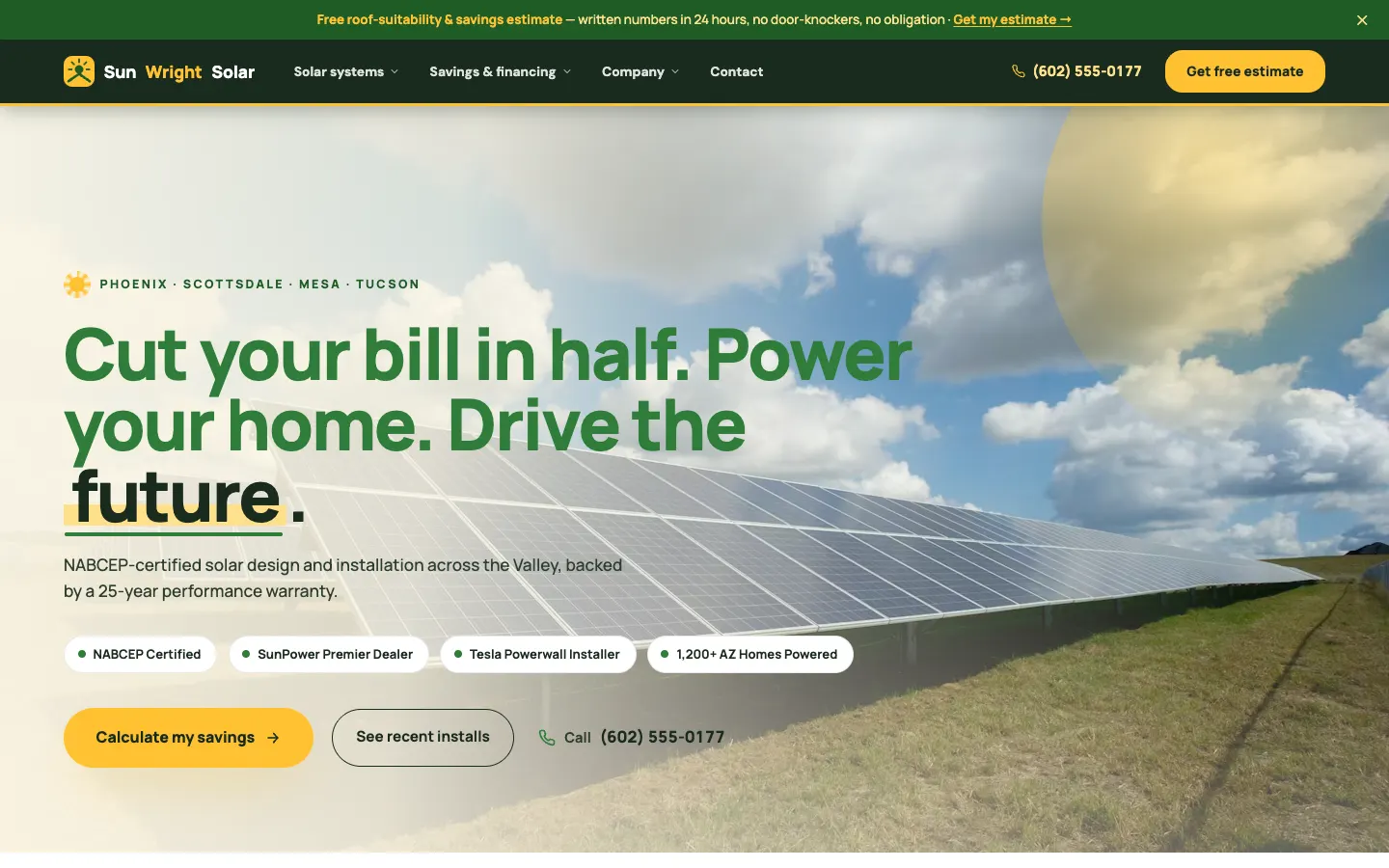
Solar Installers: a site we built, live right now.
Open any of these and use it. They run on WorkspaceCMS, on their own domains, at the speed and structure a client gets. The businesses are invented, because these are demonstration builds rather than client sites.
Free website build
We build the site. You run it on a plan.
Start a 12-month WorkspaceCMS plan and we design and build your website from scratch at no cost. The build is included. The platform runs on a monthly plan, and the page count scales with the tier.
What Is Different Here
Why solar installers do not market like everyone else.
Demand is policy driven. A change to net metering, a state incentive closing or a federal credit deadline can double inquiry volume in a month and remove it just as quickly. Campaigns built for a stable market are the wrong shape here, and copy that quotes an incentive without a date goes quietly inaccurate.
The homeowner is doing arithmetic. They want to know what happens to the bill, what the financing costs, what happens if they move, and who honors the warranty in year twelve. That last question is why company longevity and review history convert better than panel specifications ever do.
Your industry's own reputation is part of the sale. Aggressive door to door selling and a run of installer failures left plenty of homeowners suspicious before they reach your site. Being specific, verifiable and calm about the numbers is a competitive advantage here, not just good manners.
What Gets In The Way
The problems that actually cost you revenue.
Unqualified appointments burn the calendar
Shaded roofs, aging shingles, rented homes, the wrong utility territory and low usage all disqualify a lead after somebody has driven to the house. Screening for roof age, ownership, utility and bill size before booking is the difference between a full calendar and a productive one.
Incentive copy goes stale and misleads
Credit amounts, net metering terms and state programs change on legislative schedules. A page quoting last year's numbers is not merely outdated, it is a claim a homeowner will rely on. Incentive content needs a named owner, a review date and sourcing to a current authority.
Reviews capture install pain, not sales pain
Permitting, utility interconnection and inspection can leave a system dark for weeks after installation. Customers rate the silence, not the panels. Communication during that window does more for your review profile than anything the sales team does at the kitchen table.
Price comparison hides the real difference
Homeowners collect three quotes with different equipment, financing structures and production estimates, then compare monthly payments. Lease, loan and cash outcomes are not comparable, and the lowest monthly figure often costs the most. Explaining that clearly wins deals a cheaper quote should have taken.
How We Work
What we do about it.
Qualify before the appointment
We put roof age, homeownership, utility provider and typical bill into the inquiry path, then route accordingly. Prospects who do not qualify get an honest answer instead of a visit, and the sales team spends its week in front of homes that can actually be sold.
Incentives explained and kept current
We build state and utility level pages explaining what is available, who qualifies and when it changes, with a review schedule attached. That content earns the searches homeowners actually run, and it protects you from publishing a figure that has since expired.
Proof against the industry reputation
Installed system photos with location and system size, plain warranty and monitoring explanations, named crew members, and a review request timed to activation rather than to signing. The aim is a public record that answers the suspicion a homeowner arrived with.
Services
The disciplines behind it.
Search Engine Optimization
Own the searches your buyers actually make, at any scale.
Learn moreLocal and Multi-Location SEO
Win the map pack in one market or in two hundred.
Learn morePaid Media and Google Ads
Demand you can turn on today, measured to the lead.
Learn moreContent Marketing and Digital PR
Content that ranks, gets cited, and earns links.
Learn moreWeb Design and Conversion
Fast, conversion-first sites, built and then actually maintained.
Learn moreAI and Answer Engine Optimization
Get cited by ChatGPT, Claude, Perplexity and Gemini.
Learn moreQuestions
What solar installers ask us first.
If yours is not here, a free strategy call is the fastest way to get a specific answer about your market and your numbers.
Book a Free CallAre purchased solar leads worth buying?
Sometimes as a supplement, rarely as a foundation. Purchased leads are typically sold to several installers at once, arrive with no context and convert at a rate that only works with a very disciplined call process. They also correlate with the appointment quality problems most installers already have. We would rather build inquiry flow you own, through search, local presence and referral, then use purchased volume to fill gaps rather than to carry the business through a slow quarter.
How do we market when the incentive rules keep changing?
Treat incentive content as a maintained asset rather than a campaign. Build pages per state and per utility that explain what applies, who qualifies and what the deadlines are, then assign an owner and a review date. When a program changes you update one place and every campaign pointing at it stays accurate. Deadlines are legitimate urgency and they work, but only if the date is real, because a homeowner who catches an expired claim will not call.
Why are our reviews worse than our installs deserve?
Because customers rate the wait. The gap between signing and a system producing power is filled with permits, utility interconnection and inspection scheduling, most of which you do not control and none of which the homeowner understands. Silence in that window reads as being forgotten. A scheduled sequence explaining each stage, plus a review request timed to the moment the system switches on, usually improves the rating profile more than any change to the installation itself.
Should we advertise a specific payback period or savings figure?
Be careful. Savings depend on usage, rate structure, orientation, shading and future utility rates, none of which you can promise. Blanket claims invite complaints and, in some states, regulatory attention. What works is showing the method: how the estimate is built, which inputs drive it and what the range looks like for a home like theirs. Buyers trust a transparent calculation more than a headline number, and it holds up when the proposal arrives.
Related Industries
Close enough that the playbook overlaps.
Roofing Contractors
Storm surges, insurance claims and a five-figure ticket that takes weeks to close.
Electricians
Panel upgrades, EV chargers and code corrections: licensed work sold on competence, not speed.
Home Builders
Marketing communities, floor plans and quick move in homes to buyers who tour long before they call.
Selling online instead?
This practice is built for service businesses, firms, practices and B2B. If your revenue comes from an online store, the 1Digital Agency eCommerce team has run ecommerce SEO, paid media and platform work since 2012 and is the better fit.
Markets
Where we work with solar installers.
Grow your business with 1Digital.
Get a free audit and a written scope built for solar installers.