Free strategy call and written scope for local, regional and national brands. Book yours →

Home / Industries / Financial and Mortgage / Wealth Management
Regional and national
Wealth Management marketing.
Nobody with real assets picks a firm from an ad. We build the visibility, proof and referral surface that survive a two year decision.
How do you market wealth management?
Wealth management marketing is a long consideration game aimed at a small number of qualified households. It runs on content serious enough that a prospect and their attorney respect it, visibility around liquidity events such as a company sale or a concentrated position, and material professionals can forward when they make an introduction. The SEC Marketing Rule governs testimonials and any use of past performance.
See It Working
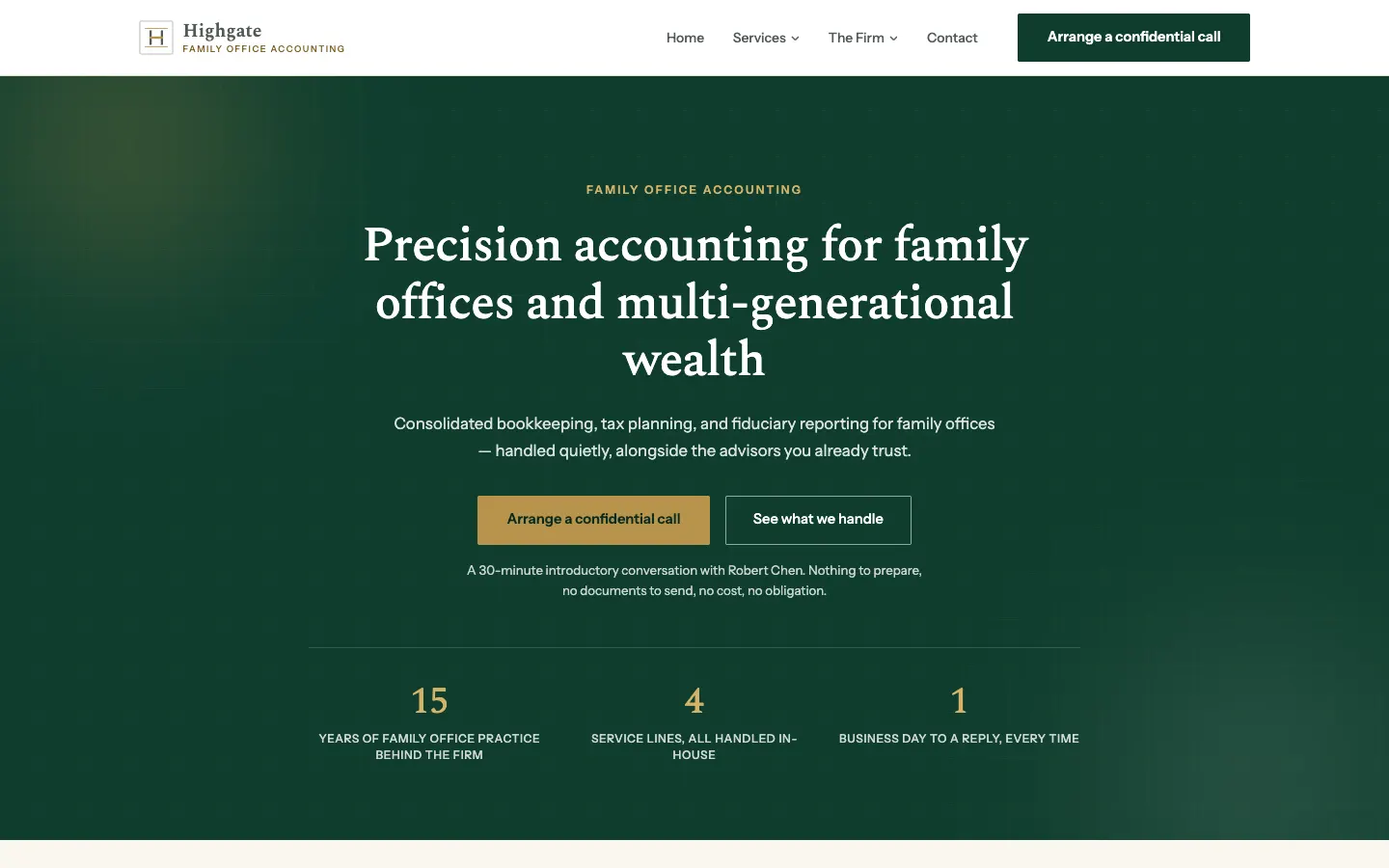
Wealth Management: a site we built, live right now.
Open any of these and use it. They run on WorkspaceCMS, on their own domains, at the speed and structure a client gets. The businesses are invented, because these are demonstration builds rather than client sites.


Free website build
We build the site. You run it on a plan.
Start a 12-month WorkspaceCMS plan and we design and build your website from scratch at no cost. The build is included. The platform runs on a monthly plan, and the page count scales with the tier.
What Is Different Here
Why wealth management do not market like everyone else.
A household with substantial assets does not respond to an offer. They ask two people they trust, then read quietly for months. By the time a first meeting is booked, your site, your team page, your Form ADV and probably a podcast appearance have already been reviewed. This is not lead generation. It is being credible and findable during a private evaluation you never see.
The triggers are concentrated and identifiable: a company sale, an equity vesting date, a concentrated position, an inheritance, a divorce, a move across state lines with tax consequences. Each has its own vocabulary and its own timeline. Content built around those events reaches people at the point where changing firms is genuinely on the table.
Scale works against you in the usual channels. Where a firm's minimum sits well above the mass market, most traffic is unqualified by definition and volume metrics mislead badly. It is better to be the obvious answer to a narrow question asked by a few hundred right people than to be broadly visible to the wrong ones.
What Gets In The Way
The problems that actually cost you revenue.
Volume metrics measure the wrong audience
A page can attract thousands of readers and none of them meet the minimum. Firms optimizing for sessions drift into beginner content that pulls exactly the households they cannot serve, then conclude that marketing does not work for their model. The qualifying signal is the question being asked, not the traffic count.
Performance and hypotheticals are restricted
The SEC Marketing Rule sets conditions on hypothetical, related, extracted and predecessor performance. Much of what a firm would naturally want to show a prospective client either cannot appear in general marketing or requires policies, records and disclosures that most marketing teams have never had to build before.
Introductions have no follow up path
Accountants, estate attorneys and business brokers make the introductions that matter, then the process goes quiet. Most firms have nothing designed for that moment: no page explaining onboarding, the service team, the planning process, or what the first ninety days of a new relationship actually look like.
Every partner sounds like every other
Team pages read as interchangeable: a credential list, a portrait, a sentence about integrity and stewardship. A family comparing three firms has nothing to choose between. What differentiates is the specific work, the household type served, and how the firm reaches investment and planning decisions.
How We Work
What we do about it.
Content aimed at the liquidity event
We build around the transitions that put assets in motion: selling a company, unwinding a concentrated position, an inherited portfolio, an executive compensation package. Each gets a substantive piece written at the level a client's attorney would read without wincing, with a clear and unhurried path to a first conversation.
A referral surface for centers of influence
Pages written for the introducer, not only the prospect: how the firm works alongside outside counsel and accountants, the planning process, the team a client actually meets, and the boundaries of what you do. It gives a professional something safe to forward, which is where most introductions cool.
Compliance ready structure from the start
We build to your marketing policies, keeping performance out of general marketing entirely and handling testimonials with the disclosures the rule requires. Files arrive in a form your chief compliance officer can review and archive, and the site keeps a record of what was published and when.
Services
The disciplines behind it.
Search Engine Optimization
Own the searches your buyers actually make, at any scale.
Learn moreLocal and Multi-Location SEO
Win the map pack in one market or in two hundred.
Learn morePaid Media and Google Ads
Demand you can turn on today, measured to the lead.
Learn moreContent Marketing and Digital PR
Content that ranks, gets cited, and earns links.
Learn moreWeb Design and Conversion
Fast, conversion-first sites, built and then actually maintained.
Learn moreAI and Answer Engine Optimization
Get cited by ChatGPT, Claude, Perplexity and Gemini.
Learn moreQuestions
What wealth management ask us first.
If yours is not here, a free strategy call is the fastest way to get a specific answer about your market and your numbers.
Book a Free CallHow do wealth management firms grow without advertising performance?
By competing on process and fit rather than returns. Publish how you make decisions, how planning and investment management work together, what a client's first year involves, and the specific situations your team handles well. Pair that with visibility around liquidity events and real relationships with accountants and estate attorneys. The SEC Marketing Rule restricts performance presentation heavily in general marketing, which is precisely why the firms that grow are usually the ones with the clearest explanation of their process.
Does search marketing work for a firm with a high minimum?
Yes, but the target changes completely. Do not chase broad terms like investment advisor. Target the narrow questions a qualified household asks: what to do with a concentrated stock position, how to plan around a business sale, how a family office differs from an advisory firm, the tax consequences of changing state residency. Volume is small and intent is very high. We measure qualified conversations rather than traffic, and we do not guarantee rankings.
Can we publish client stories or case studies?
Carefully. A client story describing outcomes can read as a testimonial or as performance advertising, and both carry conditions under the SEC Marketing Rule, including disclosure of compensation and conflicts. Anonymized composites raise their own problems if they imply a typical result. A safer and often stronger format is a process piece: the type of situation, the questions it raises, and how your team works through it, without outcome claims. Your compliance officer approves before anything publishes.
How long before marketing produces a new relationship?
Plan in quarters, not weeks. The consideration period for a large household runs months and often longer, and it usually closes when an external event forces a decision rather than when your campaign peaks. Watch the early signals instead: inbound arriving with the right kind of question, real time spent on process and team pages, and introductions from professionals who finally have something to send. We do not promise a timeline or a number of relationships.
Related Industries
Close enough that the playbook overlaps.
Financial Advisors
Marketing an advisory practice inside SEC and FINRA ad rules, built around referrals and life events.
Accounting and CPA Firms
Search and content for CPA firms shifting from seasonal compliance work to year-round advisory.
Commercial Real Estate
Marketing to investors, tenants and capital: deals surface on platforms, mandates are won on reputation.
Selling online instead?
This practice is built for service businesses, firms, practices and B2B. If your revenue comes from an online store, the 1Digital Agency eCommerce team has run ecommerce SEO, paid media and platform work since 2012 and is the better fit.
Markets
Where we work with wealth management.
Grow your business with 1Digital.
Get a free audit and a written scope built for wealth management.