Free strategy call and written scope for local, regional and national brands. Book yours →

Home / Industries / Healthcare and Medical / Physical Therapy
Local and regional
Physical Therapy marketing.
Physician referrals still drive volume, but patients can often come straight to you. Marketing has to serve both doors at once.
How do you market physical therapy?
Physical therapy marketing works on two doors. Physician and surgeon referrals remain the largest volume source, and those relationships are maintained with fast scheduling and clear progress reporting. The second door is direct access, where a patient books without a referral, and most patients do not know it exists. Rank for the injury and the post-surgical protocol, explain direct access rules for your state plainly, and show how soon someone can start.
See It Working
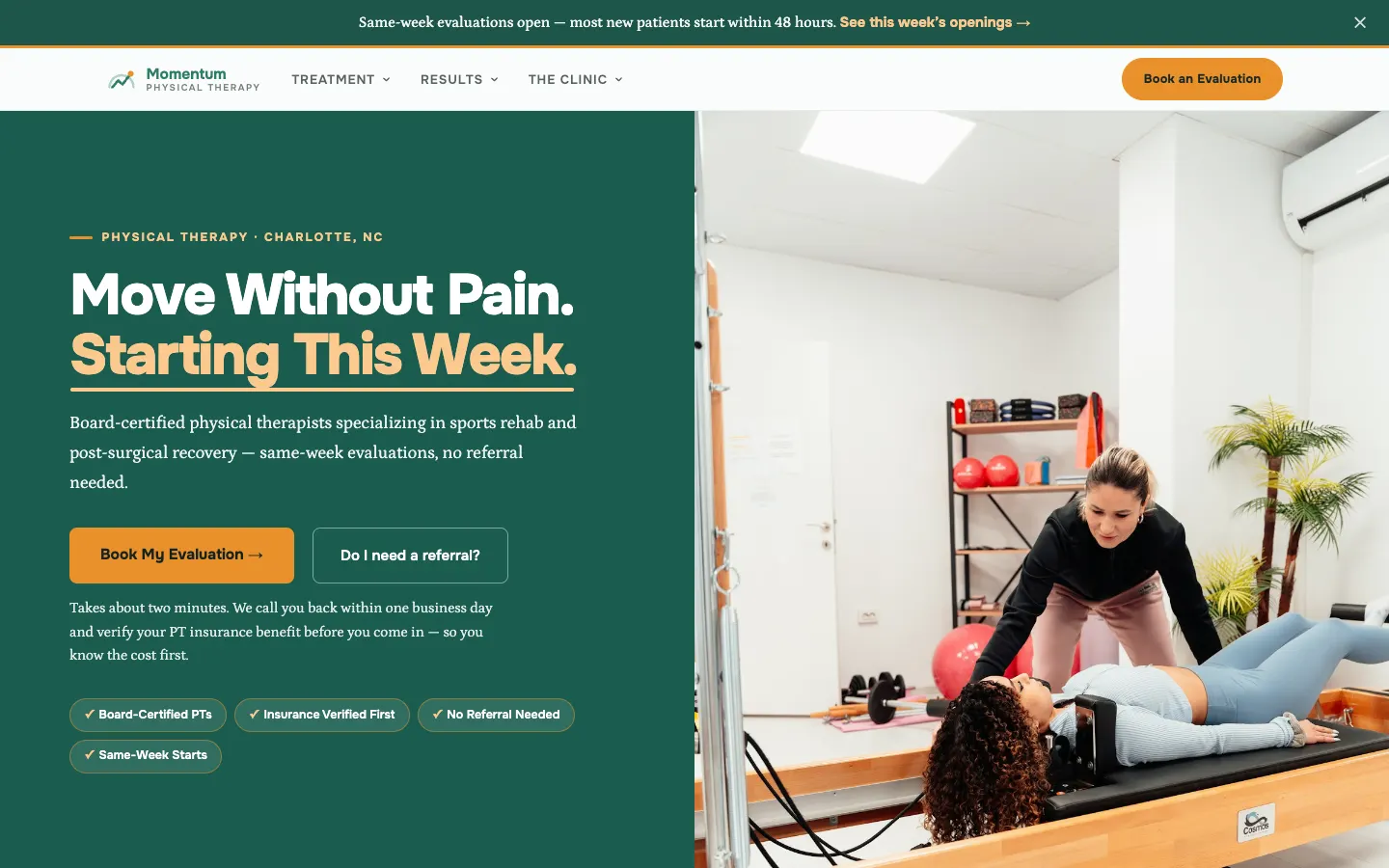
Physical Therapy: a site we built, live right now.
Open any of these and use it. They run on WorkspaceCMS, on their own domains, at the speed and structure a client gets. The businesses are invented, because these are demonstration builds rather than client sites.


Free website build
We build the site. You run it on a plan.
Start a 12-month WorkspaceCMS plan and we design and build your website from scratch at no cost. The build is included. The platform runs on a monthly plan, and the page count scales with the tier.
What Is Different Here
Why physical therapy do not market like everyone else.
Two doors lead into a physical therapy clinic and they behave nothing alike. Behind one is an orthopedic surgeon's office scheduling a post-operative protocol. Behind the other is a runner with a sore knee who has been putting it off for six weeks. The referral door is defended by relationships and turnaround time. The direct door is defended by search visibility and by a patient understanding they are allowed to walk through it.
Direct access is the underused half. State rules vary in duration and scope, and the average patient assumes a doctor's note is mandatory. A clinic that explains its own state's rules in plain language captures demand that its competitors are unknowingly leaving on the table, because almost nobody in the category writes that page well.
Course of care is where the money and the risk both sit. A plan of care runs several weeks across many visits, and attendance decays. A patient who feels better at week three stops coming, does not complete rehabilitation, and is more likely to reinjure. Reducing that drop-off is a communication problem as much as a clinical one, and it is worth more than another paid search campaign.
What Gets In The Way
The problems that actually cost you revenue.
The referral relationship is the whole business
A single orthopedic group can represent a large share of a clinic's schedule, and that dependency is invisible until the surgeon retires or the hospital system buys the practice and directs referrals in house. Clinics discover the concentration risk only when the volume disappears.
Nobody knows direct access exists
Most patients believe they need a physician referral before they can see a therapist. Rules differ by state and by insurer, and clinics rarely explain their own situation clearly. The result is a large pool of self-motivated patients who never search for a clinic at all because they think the door is closed.
Attendance collapses mid-plan
Patients start feeling better around the middle of a plan of care and stop attending. Reimbursement, outcomes and reinjury rates all suffer. Clinics treat this as a scheduling problem when it is usually an expectation problem, set at evaluation and never reinforced afterwards.
Cash-pay and hybrid models confuse the offer
Clinics running cash-based or hybrid models compete against insurance-billing neighbours whose visit copay looks smaller on paper. Without clearly explaining session length, one-to-one time and total course cost, the cash clinic loses a comparison it would win on the actual numbers.
How We Work
What we do about it.
Write the direct access page properly
A page that states your state's rules, how many visits or days are permitted before a referral is required, what your clinic needs from a patient and how fast an evaluation can be scheduled. Written plainly, it converts an audience that had assumed it needed permission to call you.
Content built around injuries and protocols
Pages for the specific searches patients and referrers use: post-operative protocols, sports injuries, vestibular, pelvic health, work injury. Each names the conditions, the therapists who handle them and the expected course. Clinical detail is reviewed by your therapists before publication.
Support referrers, and diversify away from one
A referring provider section with easy submission and clear turnaround commitments, plus outbound work to widen the referral base beyond a single group. We report referral and direct access volume separately so you can see concentration risk before it becomes a revenue problem.
Services
The disciplines behind it.
Search Engine Optimization
Own the searches your buyers actually make, at any scale.
Learn moreLocal and Multi-Location SEO
Win the map pack in one market or in two hundred.
Learn morePaid Media and Google Ads
Demand you can turn on today, measured to the lead.
Learn moreContent Marketing and Digital PR
Content that ranks, gets cited, and earns links.
Learn moreWeb Design and Conversion
Fast, conversion-first sites, built and then actually maintained.
Learn moreAI and Answer Engine Optimization
Get cited by ChatGPT, Claude, Perplexity and Gemini.
Learn moreQuestions
What physical therapy ask us first.
If yours is not here, a free strategy call is the fastest way to get a specific answer about your market and your numbers.
Book a Free CallDo patients need a physician referral to see us?
In most states patients have some form of direct access, but the limits differ: some cap the number of visits or days before a referral is needed, and some insurers impose their own requirement regardless of state law. The practical marketing point is that patients assume they need a referral, so they never search. A clear page stating your state's rules, your insurers' requirements and how fast you can schedule an evaluation reaches demand your competitors are not addressing.
How do we reduce drop-off in the middle of a plan of care?
Set the expectation at evaluation and reinforce it after. Tell the patient plainly that feeling better around the midpoint is normal and is not the same as being rehabilitated. Then support that with appointment reminders, short progress summaries and a re-engagement message when someone misses two sessions. This is worth more than additional acquisition spend, because the visits are already scheduled and the patient is already yours.
Most of our patients come from one orthopedic group. Is that a problem?
It is a risk worth measuring now rather than later. Referral concentration is fine until the group is acquired, a surgeon retires, or a hospital system starts directing referrals to its own clinics. Keep serving that relationship well, and at the same time build direct access visibility and widen the referrer base. We report the two channels separately so the concentration is visible in a number rather than discovered in a quiet month.
We are a cash-based clinic. How do we compete with in-network practices?
Compare the real thing, which is the full course of care, not the copay. Show session length, how much one-to-one time with a therapist a patient actually gets, how many visits a typical case takes and what the total looks like. Many patients discover that fewer, longer sessions cost less overall than a high-volume in-network plan. Publish the numbers, explain out-of-network reimbursement, and let the comparison happen on your page rather than in the patient's head.
Related Industries
Close enough that the playbook overlaps.
Chiropractic Care
Acute pain converts today. Everything else is a care plan you have to earn.
Medical Practices
Patients search by symptom, choose by provider, and book only if their plan is in network.
Gyms and Fitness Studios
Sign ups spike in January and leak all year. Retention decides whether the marketing paid off.
Selling online instead?
This practice is built for service businesses, firms, practices and B2B. If your revenue comes from an online store, the 1Digital Agency eCommerce team has run ecommerce SEO, paid media and platform work since 2012 and is the better fit.
Markets
Where we work with physical therapy.
Grow your business with 1Digital.
Get a free audit and a written scope built for physical therapy.